Digital design is no longer limited to websites, posters or computer laboratories. It influences how we learn, communicate, travel, shop, work, receive healthcare and interact with technology.
From mobile applications and hospital systems to educational platforms, animated films, banking services, smart farming and public transport, digital design helps turn information, ideas and technology into experiences people can understand and use.
For school students, learning digital design is not simply about making something look attractive. It is about learning how to think clearly, organise ideas, solve problems and create meaningful digital experiences.
Digital Design Across Industries
Almost every modern industry uses digital design in some form.
Healthcare uses digital interfaces to help doctors and patients understand information. Engineering uses digital models and interactive simulations to explain complex systems. Education uses visual lessons, online platforms and interactive activities to make learning more engaging.
Retail and banking depend on user-friendly websites and applications. Media and entertainment use animation, storytelling, sound and interaction. Agriculture, transport, tourism, architecture, science and public services all use digital tools to communicate information, manage systems and improve user experiences.
This means digital design is not one isolated career subject. It is a foundation that connects creativity, technology, communication and problem-solving.
Digital Design Across School Subjects
Digital design can help students understand and present ideas from many areas of study.
In mathematics, students can explore patterns, grids, proportion, measurement and logical sequences. In science, they can create animated explanations of ecosystems, space, energy, machines or the human body.
Language students can design visual stories, poems and presentations, while social studies projects can include interactive timelines, maps and cultural topics. Art students can explore colour, typography, composition and movement, and computer studies can connect these ideas with coding, animation and interaction.
This turns learning into an active process where students research, organise, create and explain.
Learning to Think, Not Just Use Software
Technology changes quickly. A particular application may become outdated, but strong thinking skills remain valuable.
Digital design encourages students to ask:
- Who is this for?
- What should the user understand?
- How should information be organised?
- What should happen when someone clicks or interacts?
- How can the design work on different screen sizes?
- How can the project be tested and improved?
These questions develop design thinking, computational thinking and user awareness. Students begin to understand that successful digital work requires both imagination and logic.
From Ideas to Interactive Projects
Through hands-on projects, students can combine text, images, icons, layouts, code, animation and interaction.
They may create an animated science explanation, an interactive school campaign, a digital story, a simple quiz, a responsive information page or a visual presentation for a subject they are studying.
The aim is not to make every student a professional programmer or designer immediately. The aim is to help them become confident creators who understand how digital experiences are planned and built.
Future-Ready Skills and Career Awareness
Digital design introduces students to skills connected with many future pathways, including:
- UI/UX design
- Web and application design
- Animation and motion design
- Creative coding
- Game and interaction design
- Digital marketing
- Product design
- Architecture and visualisation
- Media and communication
- Software and technology
- Entrepreneurship
Even students who choose careers outside technology can benefit. Doctors, teachers, engineers, scientists, business owners and researchers all need to present ideas clearly, use digital tools responsibly and understand how people interact with information.
More Than Screen Time
When students only consume digital content, the screen entertains them.
When they learn digital design, the screen becomes a canvas, laboratory and problem-solving space.
They learn to plan, create, test, improve and present their own work. In the process, they develop creativity, logical thinking, communication, patience, confidence and digital responsibility.
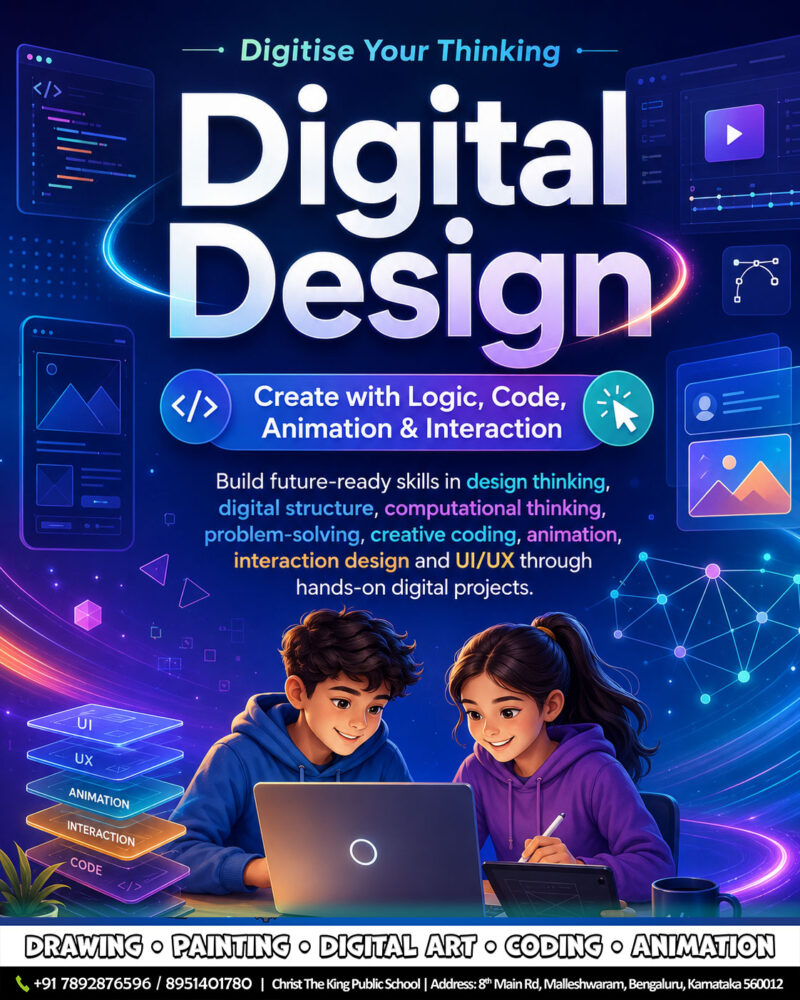
Digital Design helps students move from simply using technology to understanding and creating with it. We have introduced it as part of our creative camp’s hobby classes.